
Harbor maneuvering remains the most dreaded moment for boaters. Crosswinds, tight slips, crowded pontoons, a missing crew member this weekend… The right boat maneuvering system changes everything. Not just in terms of comfort—but in safety, confidence, and frankly, the desire to go out more often.
This guide reviews the maneuvering equipment available today for boats from 10 to 25 meters and beyond, helping you understand what truly fits your needs.
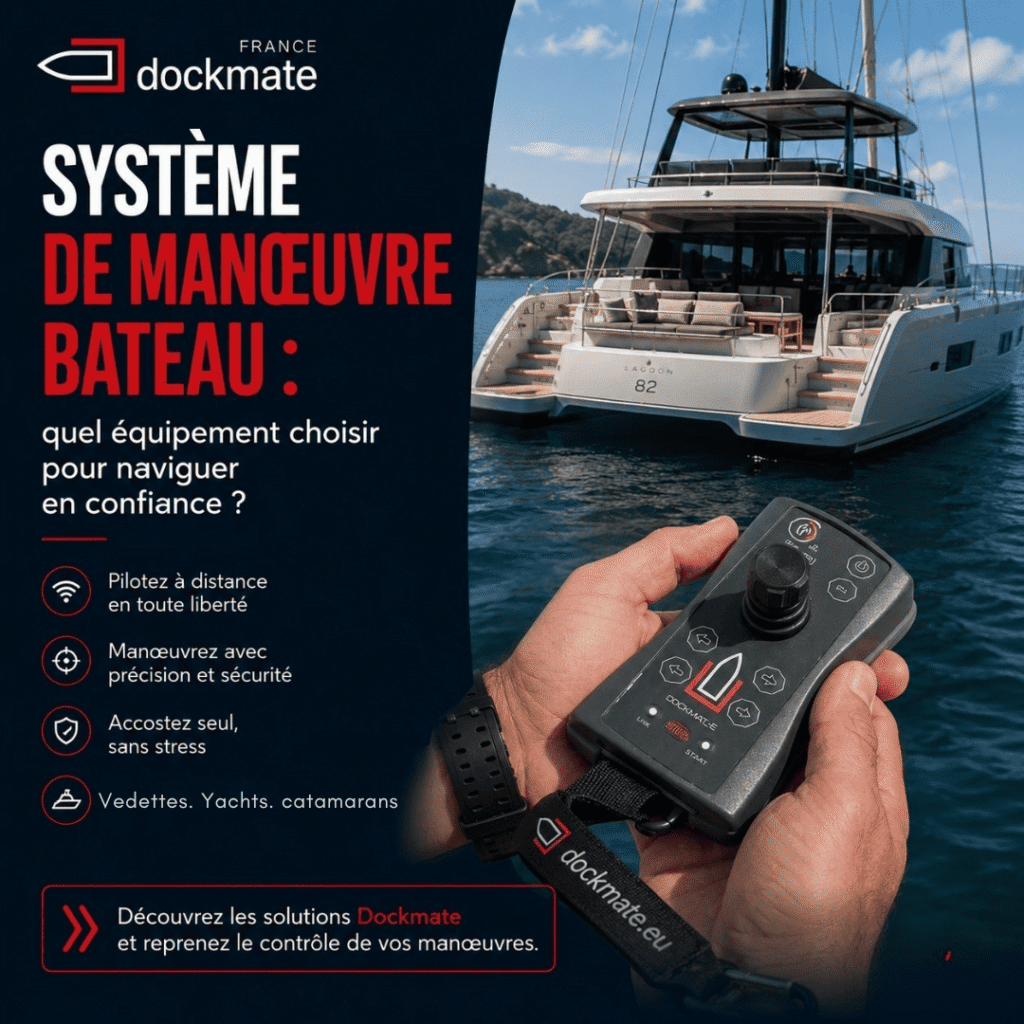
What is a boat maneuvering system?
A boat maneuvering system is the set of equipment that allows you to precisely control your vessel’s movements—forward, reverse, lateral translation—during harbor maneuvers. The engines are the foundation, but they alone are no longer enough once a boat exceeds 11-12 meters or when conditions become complicated.
A good boat maneuvering system today relies on three components: the engines, maneuvering auxiliaries (bow thruster, stern thruster), and the control mode—fixed or remote. It is this third point that has evolved the most in recent years.
Essential maneuvering equipment
Twin engines: the ultimate maneuvering equipment
On a boat of 10 to 15 meters, twin engines remain the most effective configuration for harbor maneuvers. Two independent propellers allow for rotations on the spot and controlled translations—a level of precision that a single engine cannot offer without a bow thruster. Twin-engine maneuvering techniques are worth practicing—it is a powerful maneuvering setup, but it requires practice to get the best out of it.
Bow thruster: useful, but limited
The bow thruster has become almost standard on boats of 11 meters and more. It pushes the bow laterally without engaging the engines, which considerably simplifies harbor maneuvers in tight spaces. Its limitation: it is controlled from the helm station. You are seated, you cannot always see the edge of the pontoon at the stern, and you depend on a crew member for guidance—or you trust your intuition.
Integrated joystick: comfort at the helm, not on the deck
Some recent engine systems—Volvo Penta IPS, Mercury, Zeus—integrate a joystick that automatically coordinates engines and thrusters. This is real progress for boat engine control. But this wireless boat joystick… is not wireless. It is fixed to the dashboard. You pilot from the inside, where you cannot always see what is actually happening.
The wireless remote control: the real game-changer
This is where the boat maneuvering system takes on another dimension. Remote maneuvering equipment frees you from the navigation station. You position yourself where you see best—at the bow, on the flybridge, on the side, or even on the pontoon—and you maintain total control of the engines from that position.
Remote boat maneuvering is no longer reserved for professional sailors. It is now accessible to any boater who wants to dock alone, without stress, and without depending on a crew member.
Why remote piloting truly changes the experience
Imagine the scene: you enter a crowded marina with a 15-knot crosswind. From the helm station, you have partial visibility. You ask your crew member to guide you by voice from the deck—and the word “stop” arrives a second too late.
With a remote piloting system, you are at the bow of the boat yourself. You see the fenders, the pontoon, and the neighboring boats. You control the engines in real-time from the exact spot where the information is available. It is a complete shift in logic for harbor maneuvering—and a huge difference for the safety of your hull.
This is exactly what Dockmate remote controls allow.
Dockmate: a wireless boat maneuvering system for all sizes
Dockmate is a range of wireless remote controls that connect to your existing engine system. No need to replace the control unit, no heavy shipyard work. The module integrates with the engine control, and you pilot from a waterproof remote that fits in your hand.
For a boat of 10 to 15 meters, the Dockmate TWIST is the benchmark. It manages twin engines and bow thrusters from a single remote. Its concrete advantages: you dock alone, you are mobile on the deck, and you no longer need a crew member dedicated to the lines.
For a yacht of 15 to 25 meters and beyond, the Dockmate VECTOR or Dockmate PRO support IPS, Zeus systems, or multi-engine configurations. At this level, the stakes go beyond comfort: it is about hull preservation, reducing the risk of contact during harbor maneuvers, and the ability to maneuver with a reduced crew. These are criteria that carry weight when the boat represents an investment of several hundred thousand dollars.
The system also integrates DPS—a virtual boat anchor that keeps your vessel in a fixed position against the wind and current while preparing the lines. On large vessels, this is a considerable asset.
Safety and maneuvering equipment: the direct link
A good boat maneuvering system also means fewer accidents in the harbor. Pontoon contacts, hull scratches, fenders that fail at the wrong time—all this happens when there is a lack of visibility or control. Boat safety equipment and maneuvering equipment are therefore closely linked: one does not go without the other.
How to choose your boat maneuvering system?
Three simple questions to guide your choice:
1. What is your engine configuration?
Compatibility between your current engines and a remote control system is the first criterion. Analog, electronic, IPS, Zeus—each configuration has its solutions.
2. Do you often sail alone or with few crew members?
If so, remote piloting is not a luxury; it is a practical necessity for maneuvering a boat remotely with total autonomy.
3. What size is your boat?
Between 10 and 15 meters, 15 and 25 meters, or beyond—boat engine control needs vary, and the Dockmate ranges cover every segment.
Once the system is chosen, all that remains is to install it: we explain how a Dockmate installation works.
👉 Test your boat’s compatibility with Dockmate — free, two minutes, and you will know exactly where you stand.
FAQ — Boat maneuvering system
Which maneuvering system should I choose for a 12-meter boat?
On a 12-meter boat, the combination of twin engines + bow thruster covers the vast majority of harbor maneuvering situations. What truly makes the difference at this size is the ability to pilot from the deck rather than the helm station—a wireless remote like the Dockmate TWIST gives you this freedom while maintaining total control of the engines and thruster from a single device.
Is a remote boat maneuvering system compatible with my current engines?
In the vast majority of cases, yes—whether your engines are analog or electronic, single or twin. Dockmate covers a very wide spectrum of configurations, including Volvo Penta IPS systems and Zeus drives. The simplest way is to take the compatibility test directly on the site: enter your engine details and you will get an immediate answer.
Can you really dock alone with wireless maneuvering equipment?
Yes, and that is precisely the use for which these systems were designed. By positioning yourself at the bow of the boat—where you can actually see what is happening—you control the engines in real-time without depending on a crew member to guide you or hold a line. On boats of 15 meters and more, it has even become a standalone purchase criterion for sailors who often go out as a couple or alone.