
Boat safety rests on three pillars: mandatory equipment (life jackets, VHF, localization devices, fire extinguisher, anchoring), the right habits before and during navigation (checking the weather, monitoring the water, anticipating maneuvers), and special attention to the riskiest moments, particularly docking in port. These delicate moments, often with a reduced crew, account for the majority of incidents.
Recreational boating offers unique freedom. However, even the best-prepared outings carry risks: a delicate maneuver in a port, a sudden change in weather, or a misjudgment can quickly complicate a situation. This is why safety on board a boat has become a priority for recreational boaters. Today, modern equipment not only protects those on board, but also reduces the risks associated with navigation and maneuvering. From life jackets to remote control systems, here is the equipment that truly improves boat safety in 2026.
in this article:
Why is safety on board essential today?
Port areas accommodate more and more vessels each year. Space is tighter, and maneuvers sometimes become complex, especially when wind or current interferes.
The majority of recreational boating incidents occur at low speed. Docking, departing from the quay, and maneuvering in marinas account for a large portion of material damage.
Several factors can affect boat safety:
- Reduced visibility from the helm
- Inexperienced crew
- Changing weather conditions
- Stress during maneuvers
- Captain’s fatigue
Fortunately, current technologies help limit these risks.
What equipment is essential to improve safety on board?
Mandatory equipment depends on your cruising plan and is set out in Division 240, the French regulatory reference.
New Generation Life Jackets
Life jackets remain the foundation of any boat safety strategy.
Recent models are lighter, more comfortable, and better suited for long days of navigation. Some include automatic inflation and localization systems that facilitate rescue operations.
Their increased comfort also encourages regular wear, which directly improves safety on board.
Personal Distress Beacons
Personal GPS beacons are becoming increasingly popular equipment.
In the event of falling overboard, they quickly transmit a precise position to rescue services or other vessels equipped with compatible systems.
This technology represents a real advance for boat safety, particularly during coastal or offshore navigation.
Fire Extinguishers and Fire Suppression Systems
A fire on board remains one of the most dangerous situations at sea.
Electrical installations, batteries, or engine compartments can be the source of a fire. It is therefore essential to have suitable and regularly inspected fire extinguishers.
Good prevention contributes significantly to boat safety and also protects the investment your vessel represents.
what technologies improve boat safety?
Modern GPS and Navigation Systems
Navigation equipment has evolved considerably in recent years.
Current GPS systems offer excellent precision and allow for anticipating potential dangers. Electronic charts provide detailed information on depths, obstacles, and sensitive areas.
Thanks to these tools, boat safety has significantly improved, even for less experienced boaters.
Marine Radars
Radar remains a valuable ally when visibility conditions deteriorate.
It allows detecting vessels, buoys, and certain obstacles before they are visible to the naked eye.
This ability to anticipate directly improves boat safety during night navigation or in fog.
Onboard Cameras
Marine cameras eliminate a large portion of blind spots.
Installed at the bow, stern, or sides of the boat, they allow the captain to precisely monitor their immediate surroundings.
During docking or maneuvering in confined spaces, they become a real asset.
Crew safety: boating with two people or solo
Crew safety takes on a whole new dimension when you boat solo or with just two people—an increasingly common scenario.
The most delicate moment isn’t underway—it’s docking: you can’t be at the helm, on the bow/stern thrusters, and ready to grab a mooring line at the same time. Reducing this dependence on a crew member isn’t a comfort feature—it’s a real onboard safety issue: less rushing, fewer last-second moves.
Maneuvering Aids that Enhance Boat Safety
Bow and stern thrusters
Thrusters facilitate the boat’s lateral movements.
They allow for precise trajectory correction without excessively engaging the main engines.
This assistance considerably improves boat safety in narrow marinas or when weather conditions are difficult.
Steering Joysticks
Joystick steering systems simplify low-speed maneuvers.
The captain can move the boat with greater precision and less stress.
This technology reduces the risk of error and improves boat safety during docking.
Dynamic Positioning Systems
Dynamic positioning systems automatically maintain the boat in a precise location despite wind or current.
This function becomes particularly useful when waiting for a berth or preparing a maneuver.
The skipper thus retains greater control over the situation.
Remote control: a revolution for onboard safety
The Visibility Challenge
On many boats, visibility from the helm is not optimal.
The captain sometimes has to choose between monitoring the quay, controlling the engines, or observing the fenders.
This situation can lead to misjudgments that increase the risk of incidents.
The Advantages of Wireless Remote Controls
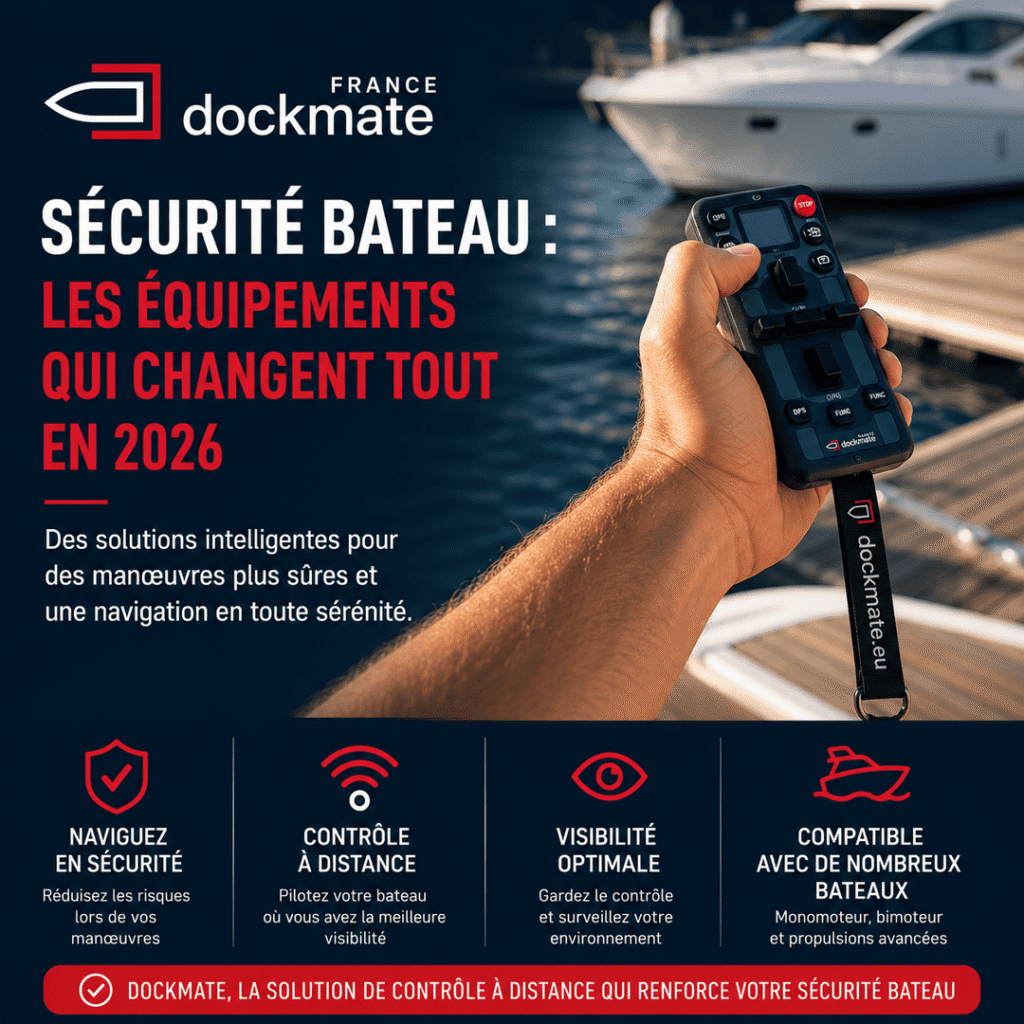
Remote control systems allow you to operate the boat from the location offering the best visibility.
The skipper can then:
- Control the engines
- Monitor the moorings
- Directly observe the distance to the quay
- React quickly to unforeseen events
- Communicate more effectively with the crew
This freedom of movement greatly improves boat safety during harbor maneuvers.
How Dockmate Contributes to Boat Safety
Dockmate solutions allow the captain to maintain complete control of their boat thanks to a secure wireless remote control.
The operator can position themselves in the most strategic location to observe their surroundings while maintaining control of the engines and thrusters.
This approach reduces stress, improves maneuver precision, and enhances boat safety in the most delicate situations.
Whether the boat is single-engine, twin-engine, or equipped with advanced propulsion, remote control offers a particularly appreciated level of comfort and safety.
What are the best practices for improving safety on board?
Safety underway: anticipate weather and traffic
Check your equipment before each outing
A quick check before departure often helps avoid unpleasant surprises.
It is recommended to check:
- Batteries
- Safety equipment
- Communication devices
- Electronic systems
- Fire extinguishers
- Life jackets
This habit directly contributes to boat safety.
Prepare maneuvers in advance
Anticipation remains one of the best tools for limiting risks.
Before each docking, it is important to assess wind and current conditions and available space.
Good preparation facilitates decision-making when pressure increases.
Regularly train the crew
Even the best equipment does not replace human skill.
Each crew member must know essential procedures and how to use the main safety devices.
A few regular exercises help to gain efficiency and peace of mind.
In summary
Boat safety relies on a balance between experience, preparation, and appropriate equipment.
Life jackets, distress beacons, navigation systems, and maneuvering aids are now essential tools for reducing risks.
Among the most significant innovations, wireless remote controls and remote control systems considerably improve maneuvers while reducing captain’s stress.
Investing in boat safety means protecting your crew, your vessel, and fully enjoying every outing at sea.
Test your boat's compatibility with Dockmate
Do you want to improve your maneuvers and enhance boat safety?
Find out in minutes if your vessel is compatible with Dockmate solutions and identify the most suitable configuration for your propulsion system.
FAQs
What is the most effective equipment for improving safety on board?
There is no single piece of equipment that can guarantee boat safety. A combination of life jackets, navigation systems, communication devices, and maneuvering aids can significantly reduce risks. Remote control technologies also provide an additional level of safety during docking and delicate maneuvers.
Are wireless boat remote controls reliable?
Yes, modern wireless remote control systems are designed with multiple levels of security and secure communication protocols. They allow the captain to maintain control of the boat while benefiting from better visibility during maneuvers.
How to reduce risks when docking?
Preparation remains essential. It is recommended to anticipate the effects of wind and current, prepare mooring lines in advance, and check visibility from the helm. Maneuvering aids such as bow thrusters or Dockmate remote controls also allow for more precise and stress-free maneuvers.
Does Dockmate really improve boat safety?
Dockmate allows the captain to operate their boat from the location offering the best visibility. This freedom of movement facilitates harbor maneuvers, reduces stress, and improves precision during docking. Many boaters use this type of technology to enhance their boat safety daily.
Is my boat compatible with Dockmate?
Dockmate solutions are compatible with many boat configurations, whether single-engine, twin-engine, or equipped with advanced propulsion systems. The easiest way to check is to perform a compatibility test to identify the suitable solution for your propulsion.
Does Dockmate replace a joystick or bow thruster?
No. Dockmate does not replace existing equipment on board. The system uses the boat’s existing controls and allows them to be operated remotely. When a boat is equipped with a joystick or thrusters, Dockmate generally allows these functions to be operated from any strategic location on board.