
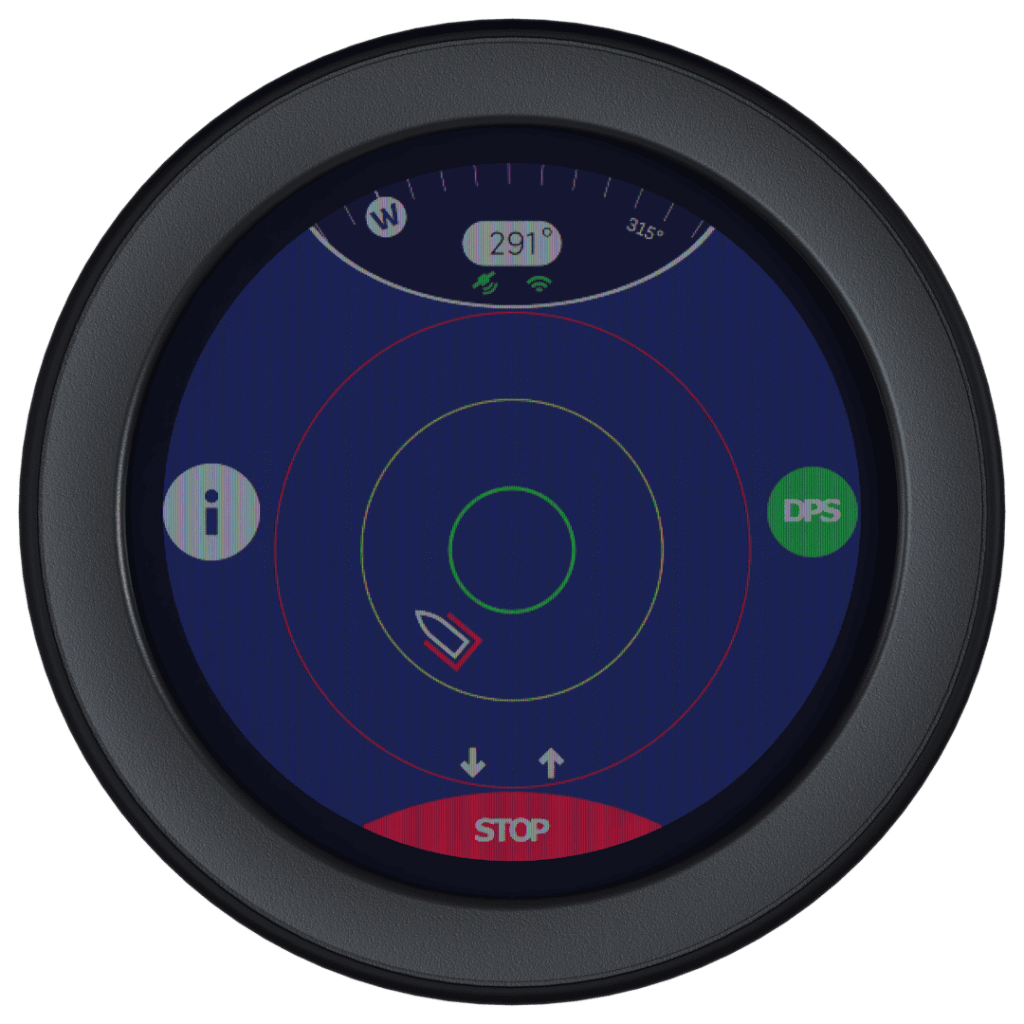
A virtual anchor is an electronic system that automatically maintains a boat at a precise position without dropping anchor, compensating for wind and current using its engines and thrusters. On a boat, this function is provided by a dynamic positioning system like the Dockmate Positioning System (DPS).
Still relatively unknown a few years ago, this technology now represents a real gain in comfort and safety for boaters, particularly during:
- waiting before entering a port
- maneuvering preparations
- navigation with reduced crew
But how does a virtual anchor actually work? Is it reliable? And in which situations does it become truly useful? In this article, discover in simple terms how a virtual boat anchor works and the advantages it brings to everyday boating.
In this article:
What is a virtual boat anchor?
A virtual boat anchor is an electronic system allowing the boat to automatically maintain its position using GPS and engine management.
Unlike a traditional anchor:
- no anchoring is required
- the boat corrects its position automatically
- the engines compensate for wind and current
👉 The system acts automatically to keep the boat within a precise area.
How does a virtual anchor work?
The operation of a virtual boat anchor relies on several combined technologies.
GPS
The system records the boat’s exact position.
Electronic calculators
They continuously analyze:
- drift
- the wind
- the current
- boat movements
Engines and thrusters
The system automatically adjusts thrust to keep the boat in place.
👉 Result: the boat remains positioned at virtually the same spot, even if conditions change slightly.
Why use a virtual anchor?
This technology becomes extremely useful in many situations.
Before a port maneuver
When waiting before entering a marina, the boat can remain automatically positioned while the crew prepares:
- the mooring lines
- the fenders
- arrival at the dock
During waiting periods while navigating
In certain situations:
- waiting for a bridge
- waiting for a lock
- waiting for fuel
👉 the virtual anchor provides real comfort.
Valuable assistance with reduced crew
For boaters navigating alone or as a couple, this virtual boat anchor technology greatly simplifies certain situations.
The boat remains stable during:
- movements on board
- maneuvering preparations
- equipment handling
👉 This significantly reduces stress.
A technology different from autopilot
Many boaters confuse:
- autopilot
- virtual boat anchor
Yet their roles are completely different.
Autopilot
It maintains a heading during navigation.
Virtual anchor
It maintains a fixed position.
👉 The two systems are complementary.

Is it really reliable?
Modern systems use:
- high-precision GPS
- fast calculators
- advanced electronic engine management
Under normal conditions, position holding is extremely effective.
⚠️ However, like any electronic aid:
- it does not replace the captain’s vigilance
- certain extreme weather conditions may limit effectiveness
Which boats can use a virtual anchor?
This technology is primarily available on:
- boats with electronic controls
- twin-engine boats
- modern joystick systems
- certain IPS or Zeus propulsion systems
👉 Technical compatibility is required.
Dockmate DPS: an advanced positioning solution
Among the most advanced solutions on the market, the Dockmate DPS system already makes it possible to automatically maintain a boat in position using GPS and electronic engine management.
⚠️ This functionality requires prior installation of a compatible Dockmate system on the boat.
But Dockmate is now going even further with the arrival of DYNAMIC DOCKING™ technology.
Unlike a simple traditional virtual anchor, DYNAMIC DOCKING™ acts directly during maneuvering and docking phases to provide active assistance to the captain.
To better understand the necessary budget, also consult our guide on Dockmate pricing.
How does DYNAMIC DOCKING™ work?
The principle is extremely simple and intuitive.
It functions as an intelligent evolution of the Dockmate wireless docking system.
The boater performs maneuvers normally with:
- the joystick
- the Dockmate remote control
- or the boat’s standard controls
👉 As soon as the controls are released, the system automatically takes over.
The boat is then:
- immediately stabilized
- held in position
- held on heading
The system automatically compensates for:
- the wind
- the current
- the boat’s natural drift
👉 Result: the boat stops drifting during thinking or maneuvering preparation phases.
A real revolution during docking
During difficult maneuvers, stress often appears when the boat continues to move while the captain:
- analyzes the approach
- prepares a mooring line
- checks the surroundings
- adjusts the trajectory
With DYNAMIC DOCKING™, the boat remains stabilized as soon as the controls are released.
This allows:
- taking your time
- better visualizing distances
- avoid constant corrections
- significantly reducing pressure during docking
👉 The system acts as a true intelligent maneuvering assistant.
Intelligent coordination of boat equipment
During dynamic position holding, the system automatically coordinates:
- the engines
- bow thrusters
- stern thrusters
to immediately correct the slightest drift.
The boat thus remains remarkably stable, even in confined spaces or with challenging weather conditions.
A technology designed to remain intuitive
One of the great advantages of DYNAMIC DOCKING™ is its ease of use.
The captain always maintains control of maneuvers.
The system intervenes only to:
- stabilize the boat
- maintain position
- maintain heading
👉 The transition between manual piloting and dynamic assistance is completely seamless.
More peace of mind, less stress
With DYNAMIC DOCKING™, Dockmate profoundly transforms the port maneuvering experience.
This technology provides:
- greater precision
- more comfort
- improved safety
- significant stress reduction
particularly in the most demanding situations:
- crosswind
- currents
- narrow marina
- reduced crew
👉 Docking becomes simpler, more precise, and much more serene.
How much does a virtual boat anchor cost?
It’s the question everyone asks before getting started, and it’s a legitimate one: the virtual anchor is a high-end system. Expect to pay between €15,000 and €17,000 to equip your boat with the Dockmate virtual anchor function (DPS, for Dockmate Positioning System). This budget places the virtual anchor in a premium category, matching what it provides: automatic, precise position holding that keeps your boat in place despite wind and current, without dropping anchor.
A price added to the cost of the Dockmate
Important point to understand: the virtual anchor is not a standalone product. The DPS is an addition to a Dockmate remote control. In practical terms, there are two scenarios. Either you equip your boat with a Dockmate and the DPS at the same time, during the same installation. Or you already own a Dockmate and add the virtual anchor function later, whenever you wish. In both cases, the virtual anchor budget of €15,000 to €17,000 is in addition to the price of the Dockmate remote itself. To find out the price of the different remote models, visit our page dedicated to the price of a Dockmate.
Technical requirements for installing a virtual anchor
The price of a virtual anchor also depends on your boat’s configuration, as not all boats can accommodate it. Two conditions are necessary. First, your boat must be Dockmate-compatible: this requires electronic controls, rather than mechanical cable controls. Second, the virtual anchor needs two proportional thrusters to precisely maintain position and correct drift. The only exception: on a catamaran, a single proportional bow thruster is sufficient, thanks to the spacing of the two engines.
If your boat doesn’t meet these conditions yet, it doesn’t mean a virtual anchor is out of reach—it means a study of your configuration is needed to evaluate what would be required. This is exactly what our compatibility test allows.
An investment to weigh against usage
A budget of €15,000 to €17,000 should always be considered in light of how it changes your daily experience. A virtual anchor offers the possibility to stop anywhere without anchoring maneuvers, to hold your position in front of a lock or a pontoon while waiting, or to secure a lunch break in a cove without depending on the seabed. For an owner who sails regularly and seeks autonomy and peace of mind, the question is not just the list price, but the comfort and tranquility gained with every outing.
A technology that changes navigation habits
Position holding systems are progressively becoming a real modern comfort on board.
Many owners report that they use this function much more often than they initially imagined.
Why?
Because it provides:
- greater peace of mind
- less stress
- greater comfort
- better boat management with reduced crew
In conclusion
The virtual boat anchor represents a true evolution in navigation comfort today.
Through automatic position holding, this technology simplifies many everyday situations and brings greater peace of mind on board.
For boaters seeking more comfort, safety, and autonomy, these systems quickly become indispensable.
👉 Want to know if your boat is compatible with Dockmate DPS solutions?
Check your boat’s compatibility here now or contact a Dockmate expert for a personalized assessment based on your configuration.
Can the boat really remain stationary despite wind and current?
The system automatically compensates for the effects of wind and current through coordination of engines and thrusters. This significantly limits drift during maneuvering phases.
Do you need to already have a Dockmate system installed to use DPS?
Yes. The DPS system and DYNAMIC DOCKING™ function require prior installation of a compatible Dockmate system on the boat.
Does DYNAMIC DOCKING™ work automatically during docking?
Yes. During your maneuvers, you pilot the boat normally with the remote control or Dockmate joystick. As soon as you release the controls, the system automatically immobilizes the boat and maintains its position and heading.
What is the price of a virtual boat anchor?
The price of a Dockmate virtual anchor (DPS function) is between €15,000 and €17,000. This amount is in addition to the price of the Dockmate remote, whether it is installed at the same time or added later to an already equipped boat.
Can the virtual anchor be installed alone, without a Dockmate?
No. The virtual anchor is a function that complements a Dockmate remote. You must therefore have a Dockmate, either by installing it at the same time as the virtual anchor, or by adding the virtual anchor later if your boat is already equipped.
What are the prerequisites for installing a virtual anchor?
Your boat must be Dockmate-compatible, meaning it must have electronic controls (mechanical cable controls are not compatible). The virtual anchor also requires two proportional thrusters—except on a catamaran, where a single proportional bow thruster is sufficient. The easiest way to find out where you stand is to test your boat’s compatibility.