
There’s a precise moment during docking when everything comes down to it: the last two meters. The boat approaches, you want to slow it down, you engage a brief burst of reverse… and nothing happens. Then everything happens at once.
This delay is familiar to all boaters. Many believe it’s a matter of experience, that with years, you eventually “feel” your boat. That’s partly true. But the real problem lies elsewhere: it’s mechanical.
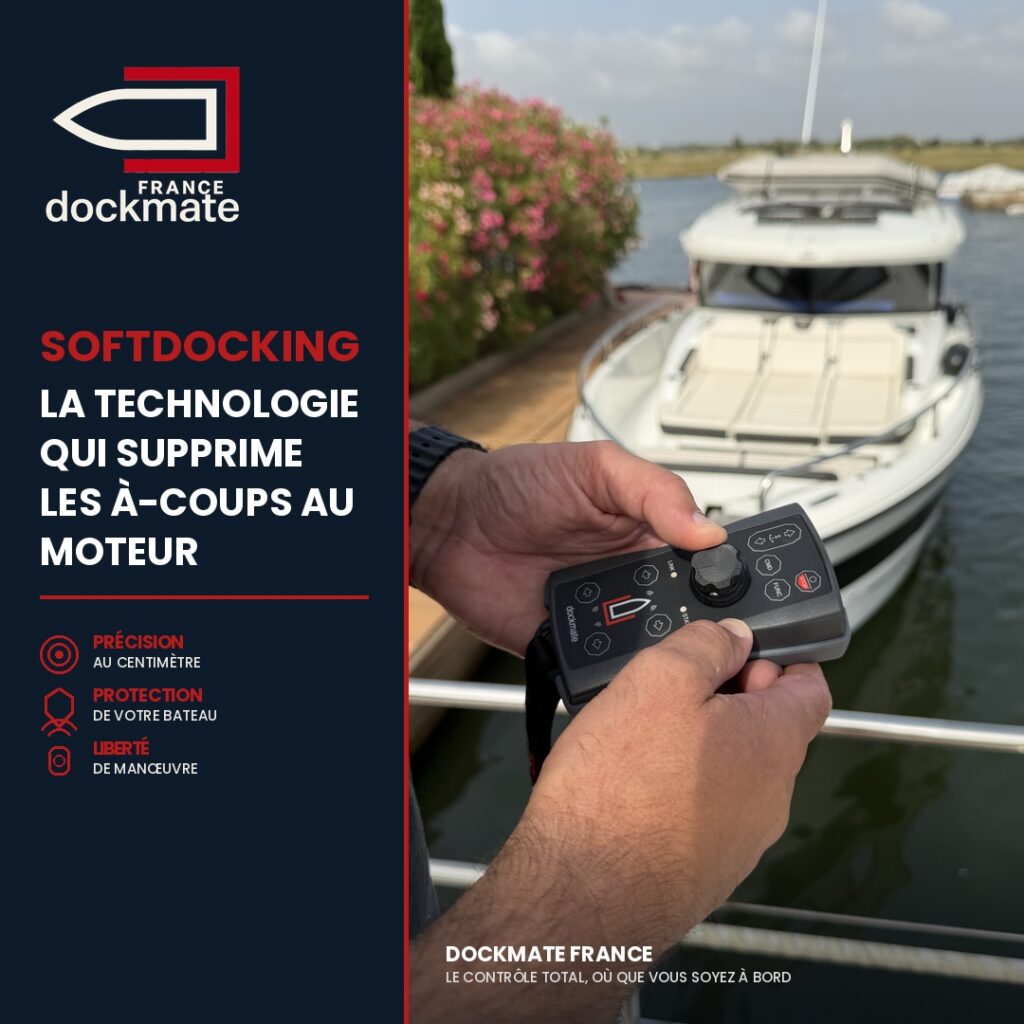
Dockmate tackled this head-on with patented technology: SoftDocking Dockmate. Its principle is simple, almost obvious once understood. And it’s probably the feature that changes daily life on board the most.
We explain how it works, on which models, and what concrete difference it makes when you return to port.
In this article
Why Your Boat Always Reacts Late
In a car, you press the pedal, and it moves. Immediately.
On a boat, no. Between the moment you engage the lever and the moment the hull actually starts to move, there’s a delay. The propeller must churn the water, the boat’s mass must be set in motion, and inertia does the rest.
Result: we misjudge. Either we give too little and nothing happens. Or we give too much and arrive at the dock too fast.
This isn’t a piloting problem. It’s a physics problem. So much so that navigation training, from licensing to advanced courses, dedicates entire modules to it.
What Exactly Is SoftDocking Dockmate?
SoftDocking Dockmate is a patented technology by Dockmate. The principle can be summarized in one sentence: a brief press of the button or joystick triggers a pre-programmed, calibrated propeller burst lasting a fraction of a second.
You no longer “shift” gears. You tap the engine.
One impulse. The boat moves a few centimeters. Another impulse. It moves a little further. You meter your approach step by step, without ever experiencing a jolt.
The impulse is customizable. It is set during installation, according to your boat: its mass, its engine, its behavior. It’s not a generic factory setting.
Three Levels of Engine Control
SoftDocking Dockmate does not work alone. It is part of a three-tiered system.
1. SoftDocking — The Impulse
A brief press. A short burst. For centimeter-precise adjustments when you are already in position.
2. Idle Power — The Idle
A sustained press. Continuous thrust at idle. For progressive movements in a channel or between berths.
3. Throttle+ — Power in Reserve
A firmer press (or the SEL + forward/reverse combination depending on the model). You get additional, calibrated acceleration per direction.
This is the level used when the wind is pushing, when the current is flowing, when immediate power is needed.
On the TWIST, no button is needed: the joystick is proportional, everything depends on the subtlety of your movement. A flick for SoftDocking, a firm push for more.
On Which Dockmate Systems?
Let’s be clear, because this is a frequently asked question.
SoftDocking is standard on all new remotes: SINGLE, TWIN, TWIST, VECTOR, and PRO. No extra charge.
It is not available on the Dockmate RED. The RED is our entry-level model, designed for boats with simple analog controls. It does the job — engines, thrusters, windlass — but with analog idle modules and on/off thrusters. No SoftDocking, no Throttle+.
This is a strategic choice, not an oversight. If SoftDocking interests you, the RED is not the right model. We want to make that clear upfront.
To learn more about the differences, we’ve detailed everything in our article Dockmate RED vs TWIN: Which is right for your boat?
What It Actually Changes During Docking
Three things.
You stop correcting. No more ping-ponging back and forth to correct an overly fast approach. Each impulse does exactly what you expect.
You protect your boat. A poorly judged jolt means a crushed fender, a dent in the hull, a gunwale scraping the pontoon. SoftDocking eliminates surprises, and thus brutal contact.
You maneuver from anywhere. SoftDocking Dockmate is integrated into the remote control you wear around your neck. Position yourself where you have the best view — at the bow, on the side, on the swim platform — and tap the engine from there. 🎯
It’s the combination of the two that makes the difference: freedom of placement, plus precision of movement.
What if your boat has mechanical controls?
An important technical point, and we won’t beat around the bush.
SoftDocking requires electronic controls. Analog electronic or CAN bus, it doesn’t matter. But electronic.
If your boat operates with mechanical cable controls, no Dockmate system is compatible. Neither SoftDocking, nor RED, nor anything. This is a physical limitation, not a commercial one.
Unsure about your configuration? That’s normal, it’s not always easy to identify. Our guide Is My Boat Compatible with Dockmate? Guide by Engine Type sorts it out.
A Technology That Isn't Just Talked About, It's Felt
We can describe the impulse, the milliseconds, the calibration. But SoftDocking is something you understand in thirty seconds on the water.
The first time you tap the engine and the boat shifts twenty centimeters, exactly where you wanted it — without a jolt, without surprise — you understand.
More than 10,000 boaters now navigate with a Dockmate, in 32 countries. And SoftDocking is consistently among the first things they mention.
Want to see the full range and detailed features? Our Dockmate Remotes and Unique Dockmate Features pages present each model.
FAQ — Your Questions About SoftDocking Dockmate
Is SoftDocking Dockmate a paid option?
No. It is included as standard on all new Dockmate remotes — SINGLE, TWIN, TWIST, VECTOR, and PRO. Without extra cost. Only the RED does not have it.
Can the impulse power be adjusted?
Yes. That’s the whole point. The impulse is calibrated during installation, based on your boat and its engine. A 10-meter RIB and a 16-meter cruiser don’t need the same amount.
Does SoftDocking work on a single-engine boat?
Yes. The Dockmate SINGLE is designed for single-engine boats with electronic controls, and it includes SoftDocking as standard, like the other models.
What's the difference between SoftDocking and Throttle+?
SoftDocking is about finesse: a brief impulse for centimeter-precise adjustments. Throttle+ is about power: additional calibrated acceleration, to counter wind or current. Both coexist on the same remote, with idle (Idle Power) in between.
SoftDocking Dockmate is included as standard on all our systems, except RED. The question remains which one suits your boat — and most importantly, if your controls are compatible.
It takes two minutes, and it costs nothing.
👉 Test your boat’s compatibility
Prefer to speak in person? You can reach us at 06 15 78 06 77 or at contact@dockmate.fr. You can also discover Dockmate France on Google.