
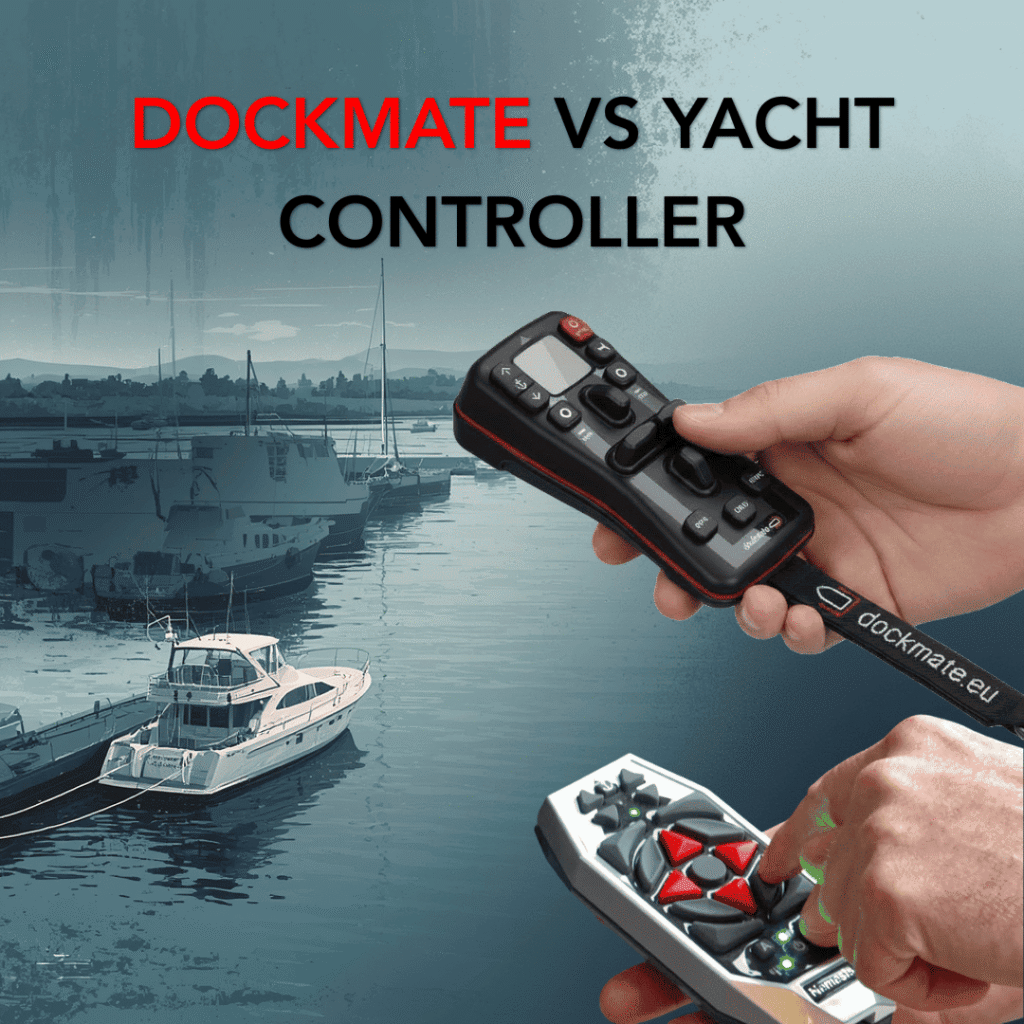
The Dockmate vs Yacht Controller comparison is now regularly discussed among boaters seeking an effective solution to simplify their maneuvers in port.
Docking a boat in a narrow marina, with wind or a reduced crew, can quickly become stressful. Wireless remote control systems now make it possible to regain control of maneuvers with much greater precision and peace of mind.
In this Dockmate vs Yacht Controller guide, discover the main differences between these two solutions to choose the system best suited to your boat and your way of navigating.
In this article
Dockmate vs Yacht Controller: Why Use a Remote Control for Your Boat?
Before comparing Dockmate vs Yacht Controller, it is important to understand why this equipment is becoming almost essential today.
A boat remote control allows you to:
- leave the helm
- improve visibility during maneuvers
- manage mooring lines more easily
- significantly reduce stress in port
👉 The captain can thus position themselves directly where they have the best view of the dock and distances.
In certain narrow marinas or during docking with crosswinds, this type of technology truly transforms the navigation experience.
Dockmate vs Yacht Controller: Two Different Philosophies
Although both brands offer remote piloting solutions, their approaches differ significantly.
Yacht Controller: A Classic Remote Control Approach
Yacht Controller is one of the pioneers in the boat remote control market.
The system primarily allows:
- engine control
- thruster management
- certain remote maneuvering functions
👉 The approach remains centered on a relatively traditional remote control.
Some configurations offer numerous commands accessible directly from the remote control, with sometimes very technical logic.
Dockmate: A Logic Focused on Precision and Ergonomics
In this Dockmate vs Yacht Controller comparison, Dockmate adopts a much more modern approach to remote piloting.
The system particularly emphasizes:
- maneuver fluidity
- piloting precision
- user ergonomics
- advanced integration with boat systems
👉 The objective is to make maneuvers more intuitive and natural.
Dockmate primarily seeks to allow the boater to remain focused on their environment rather than on the controls themselves.
Dockmate vs Yacht Controller: What Ergonomic Differences?
Ergonomics represents an essential element during maneuvers.
In stressful situations, the captain must be able to use their system instinctively, without needing to constantly look at the controls.
The Yacht Controller Approach
Some Yacht Controller remote controls feature:
- numerous buttons
- several directly accessible functions
- fairly technical logic
👉 This may suit some experienced users, but sometimes requires an adaptation period.
The Dockmate Approach
Dockmate favors much more intuitive use.
The controls are designed to:
- limit errors
- simplify gestures
- keep your eyes on the environment
Models with wireless joystick particularly allow extremely natural movements during maneuvers.
👉 Also discover our article on wireless boat joysticks.
Dockmate vs Yacht Controller: What Precision During Maneuvers?
During docking, precision quickly becomes the most important criterion.
Performance in Difficult Conditions
In a narrow port with:
- crosswind
- currents
- limited space
corrections must be immediate and progressive.
In this Dockmate vs Yacht Controller comparison, Dockmate particularly stands out for:
- response fluidity
- correction finesse
- feeling of permanent control
👉 The Dockmate system truly gives the impression of “holding” the boat.
This precision becomes particularly valuable during delicate approaches or maneuvers with a reduced crew.
A More Assisted Logic with Dockmate
The latest developments such as:
- Dockmate DPS
- DYNAMIC DOCKING™
now provide intelligent assistance during maneuvers.
The boat can:
- maintain its position
- stabilize its heading
- automatically compensate for certain drift
👉 This type of technology profoundly changes docking comfort.
In the Dockmate vs Yacht Controller comparison, this advanced assistance represents one of the major technological differences today.
You can also see a concrete example of Dockmate’s advanced piloting functions in the brand’s official demonstrations.
Compatibility with Boats
Both systems generally require:
- electronic controls
- compatible configurations
- sometimes thrusters
However, exact compatibility always depends on:
- the engine type
- the boat type
- installed equipment
👉 A technical study remains essential before installation.
In this Dockmate vs Yacht Controller comparison, compatibility remains an essential point before any installation.
Which Boats Are Most Concerned?
These solutions are particularly suited to:
- twin-engine powerboats
- catamarans
- yachts
- boats with thrusters
- boaters who navigate regularly
👉 Also discover our article on twin-engine boat maneuvering.
Owners of boats with high windage or large dimensions generally experience an immediate comfort gain during docking.
Daily Comfort of Use
Beyond technology, the real criterion often remains the comfort experienced daily.
Many boaters primarily seek:
- less stress
- greater peace of mind
- better autonomy
- more confidence during docking
Dockmate: A More Modern Approach to Navigation
In this Dockmate vs Yacht Controller comparison, Dockmate particularly appeals to boaters seeking:
- great ease of use
- a premium experience
- intelligent maneuvering assistance
Recent systems particularly allow you to:
- automatically stabilize the boat
- avoid constant corrections
- simplify approaches in difficult ports
👉 This truly changes the navigation experience.
Dockmate vs Yacht Controller: Which System to Choose According to Your Navigation?
The choice primarily depends on:
- your way of navigating
- the level of comfort sought
- your experience
- your boat configuration
Yacht Controller may suit:
- users seeking a classic approach
- boaters accustomed to technical remote controls
Dockmate will particularly suit:
- users seeking more intuitiveness
- boaters navigating alone or as a couple
- owners wishing to maximize comfort in port
- users seeking the most recent technologies
Why Remote Piloting Systems Are Becoming Essential?
Today, this equipment is no longer exclusively reserved for very large yachts.
It is gradually becoming a true standard to:
- improve safety
- reduce maneuvering errors
- gain autonomy
- rediscover pleasure during docking
👉 Navigation habits are evolving rapidly.
Boaters now seek solutions capable of providing:
- more peace of mind
- better control
- a smoother experience in port
Final Word
In this Dockmate vs Yacht Controller comparison, both solutions can significantly improve maneuvers in port.
However, Dockmate particularly stands out for:
- its intuitive ergonomics
- its advanced technologies
- its intelligent functions such as DYNAMIC DOCKING™
- and its daily comfort of use
Boaters seeking a modern, fluid, and reassuring experience during docking will particularly appreciate this approach focused on simplicity and precision.
👉 Want to know if your boat is compatible with a Dockmate solution?
Check now your boat’s compatibility or contact a Dockmate expert for a personalized study according to your configuration.
In the Dockmate vs Yacht Controller comparison, what is the main difference?
Dockmate favors a very intuitive approach and advanced maneuvering assistance functions, while Yacht Controller adopts a more classic boat remote control logic.
Can these systems be installed on an existing boat?
Yes, most modern boats with electronic controls can be compatible.
Which system is best suited for navigating alone?
Solutions offering great ease of use and active assistance during maneuvers are generally the most comfortable for solo navigation.
Do Dockmate DPS and DYNAMIC DOCKING™ exist with Yacht Controller?
Dockmate now offers advanced dynamic position-holding functions and intelligent docking assistance that significantly enhance maneuvering comfort.