
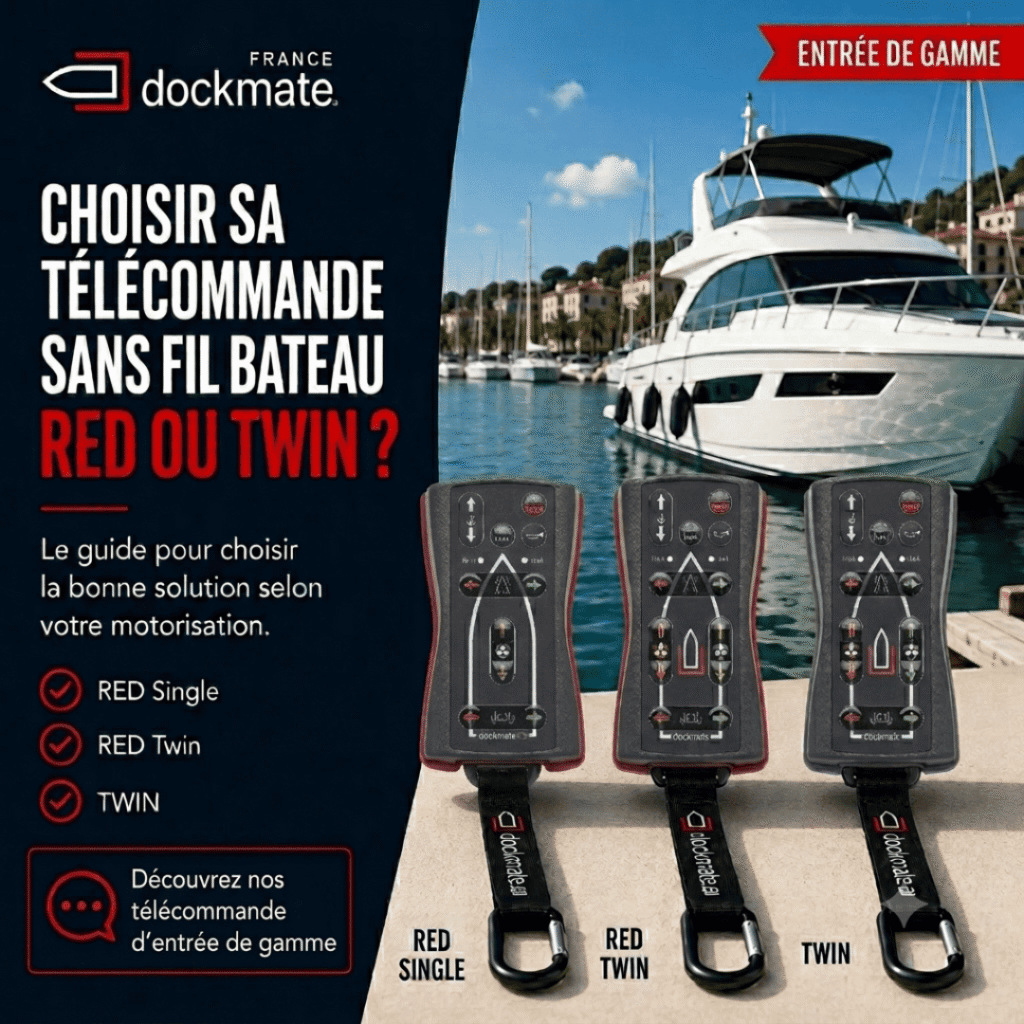
Choosing your wireless boat remote is not just a matter of budget. It is primarily a question of compatibility with your engine system — and if you make the wrong choice, the remote will simply not work on your boat. This guide helps you choose your wireless boat remote between the Dockmate RED and the Dockmate TWIN, the two entry-level models in the Dockmate range — trusted by over 10,000 boaters in 32 countries.
In this article:
Before choosing your wireless boat remote: the shared fundamentals
RED and TWIN share the same foundations. Both wireless boat remotes are IP67 waterproof, float, have a 50-meter range, operate on the bidirectional DockLink2 protocol, and feature wireless charging. Made in Belgium, with a three-year warranty. Regarding reliability and robustness, there is no difference between the two models.
What separates them is the engine system they can control — and the functions they include.
The Dockmate RED: choosing your wireless boat remote for analog engines
Who is the RED for?
The Dockmate RED is the wireless boat remote designed for boats with analog controls. It is available in a single-engine version (RED Single) or twin-engine version (RED Twin). It controls engines, bow thrusters, and stern thrusters — directly, without complex configuration.
It is the ideal wireless boat remote for a boater navigating a 9 to 12-meter boat with a classic analog engine system. You leave the helm station, position yourself at the bow or on the side, and steer from where you can actually see what is happening. It is a radical change in the quality of harbor maneuvers — especially when sailing solo or with a small crew.
The limitations of the RED
No SoftDocking™, no Throttle+, no ThrusterHold™. No proportional thruster control, no dual windlass. The RED embraces this positioning: it is an essential, accessible system without unnecessary extra costs. But most importantly — it is not compatible with modern electronic controls, nor with mechanical cable controls. If your boat has classic mechanical cables, no Dockmate system can be installed.
The Dockmate TWIN: choosing your wireless boat remote for electronic twin engines
How to choose your wireless boat remote: the right criterion
The Dockmate TWIN is the wireless boat remote dedicated to twin engines with electronic controls. It independently controls both engines, bow and stern thrusters, up to two windlasses, and the horn — all from a single remote worn around the neck, anywhere on deck.
For a 12 to 15-meter boat with electronic twin engines, the TWIN is the benchmark. Remote boat control takes on its full dimension here: you steer from the deck with perfect visibility of your surroundings, and you have all the precision of your engine system at your fingertips.
Exclusive functions of the TWIN
What truly distinguishes the TWIN as a wireless boat remote is its three-level engine control system: SoftDocking™ for smooth, fine adjustments, Idle Power for progressive movement at idle, and Throttle+ for extra power when wind or current demands it. Not to mention ThrusterHold™, a 2026 innovation, which keeps the thrusters engaged to hold the boat against the dock during mooring — a first for a wireless boat remote.
How to choose your wireless boat remote: the decisive criterion
Analog or electronic engine system?
A single criterion is enough to correctly choose your wireless boat remote. If your boat has analog controls — meaning simple electrical controls without complex digital integration: choose the RED. Simple, reliable, and accessible, it will immediately give you more freedom in the harbor.
If your boat has electronic controls, or if your boat exceeds 12 meters with twin engines: choose the TWIN. The price difference is justified from the very first twin-engine maneuver in a tight harbor with a crosswind, and exclusive functions like SoftDocking™ truly change daily practice.
Not sure what your engine system is?
This is the most frequent question, and it determines the entire choice. The compatibility test on the website provides the answer in two minutes: you enter your engine details and immediately know which wireless boat remote matches your configuration. It is free, with no obligation, and is by far the fastest way to choose your wireless boat remote without risk of error.
The case of the electronic single engine
If your boat has an electronic single engine, neither the RED nor the TWIN is the right wireless boat remote for you — the Dockmate SINGLE is the one that matches your configuration. The page on the wireless boat joystick details the options for advanced electronic engine systems.
Summary
Choosing your wireless boat remote between the RED and the TWIN starts with identifying your engine system. The RED is the entry point — accessible, efficient, and designed for analog. The TWIN is the natural choice as soon as the engine system is electronic and conditions require more precision. In both cases, you gain the essential: the freedom to steer from where you see best, not from the helm station.
Over 10,000 boaters have already placed their trust in Dockmate.
👉 Test your boat’s compatibility here.
FAQs: Choosing your wireless boat remote
What is the difference between the Dockmate RED and the Dockmate TWIN?
The main difference is the compatible engine system. The RED is designed for boats with analog controls — simple, efficient, without advanced functions. The TWIN is intended for electronic twin engines and includes exclusive SoftDocking™, Throttle+, and ThrusterHold™ functions for more precise and safer harbor maneuvers.
How do I know if my engine system is analog or electronic?
This is the question most boaters ask before choosing their wireless boat remote. The simplest way: take the compatibility test. You enter your engine details in two minutes and get an immediate answer on the model that matches your boat.
Can I choose a wireless boat remote for solo sailing?
Yes, that is precisely why these systems were designed. Whether it is the RED or the TWIN, you control engines and thrusters from anywhere on board — the bow, the flybridge, the side — without depending on a crew member. On a 10-meter boat as on a 15-meter twin-engine vessel, docking alone becomes a controlled maneuver, not a moment of stress.