
The wireless docking system is now an essential solution for simplifying port maneuvers.
Docking a boat, especially in a crowded marina or in difficult conditions, remains one of the most stressful moments for a boater. Between managing the throttle, thrusters, and lines, coordination can quickly become complex.
Thanks to wireless technologies, it is now possible to control your boat remotely, from the most strategic spot on board.
In this article, you will understand how a wireless docking system works, what its benefits are, and why it transforms the boating experience.
In this article:
What is a wireless docking system?
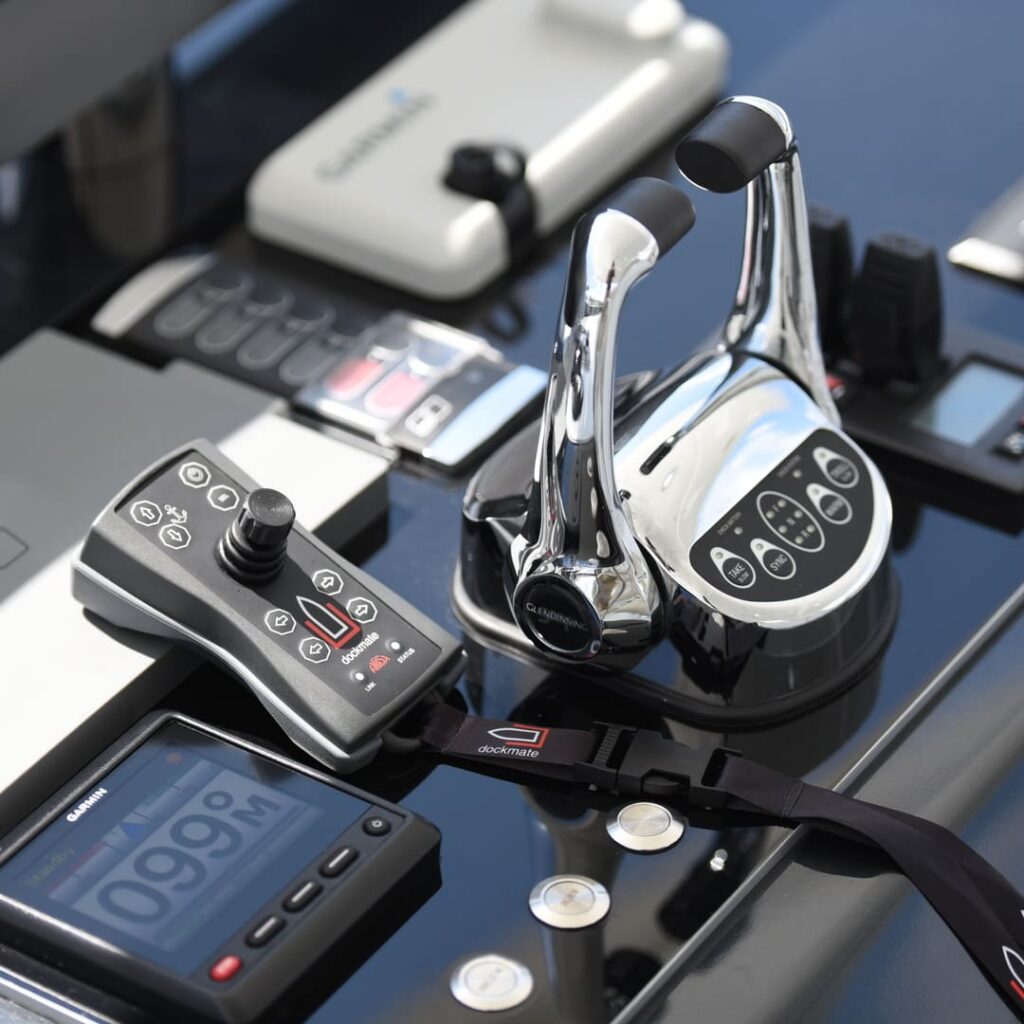
A wireless docking system allows you to control boat maneuvers remotely using a remote control.
Specifically, it replaces traditional piloting from the helm, offering more freedom of movement.
With this type of system, you can:
- move forward or backward
- control the engines
- manage thrusters
- control your windlass
- sound the horn
- adjust your position in real time
👉 All without being physically at the helm.
How does a wireless docking system work?
The operation relies on reliable and proven technology, now used on many boats.
An ergonomic remote control
It allows intuitive boat control, with simple and responsive commands.
An onboard module
This system is connected to the boat’s engines, thrusters, and other equipment.
Secure communication
The wireless connection ensures instant and reliable transmission, without latency.
👉 Result: you control your boat as if you were at the helm, but with more freedom.
Concrete example: simplified port maneuver
Imagine arriving in a port with limited space and crosswinds.
Without a wireless docking system:
- you stay at the helm
- visibility is limited
- line handling is complicated
With a wireless docking system:
- you position yourself directly at the strategic point
- you control the boat while preparing your lines
- you adjust every movement in real time
👉 Result: a smooth, precise, and stress-free maneuver.
Benefits of a wireless docking system
Improved visibility
You position yourself where you have the best view, reducing blind spots.
Increased precision
Every movement is controlled, even in confined spaces.
Reduced stress
Maneuvers become simpler and more natural.
Enhanced autonomy
Single-handed navigation becomes much more accessible.
Improved safety
You maintain total control over sensitive areas of the boat.
Which boats can be equipped?
Most modern boats can be equipped with a wireless docking system, provided they have:
- electronic controls (not cable)
- compatible engines
- ideally, thrusters
Twin-engine boats are particularly suitable, but solutions also exist for well-equipped single-engine boats.
Some systems are compatible with engines such as those offered by Volvo Penta or Mercury Marine.
👉 Compatibility verification remains essential.
Why choose a solution like Dockmate?
Among the available solutions, Dockmate stands out as a benchmark.
Exceptional piloting precision
Every command is executed instantly.
Extensive compatibility
Adapted to many boat configurations.
Intuitive handling
Accessible even for less experienced boaters.
Recognized reliability
Used by thousands of boaters.
👉 To better understand the costs, also consult our article on Dockmate pricing.
How to know if your boat is compatible?
Every boat is unique.
👉 To check compatibility, it is generally necessary to know:
- your engine type
- your equipment
- your configuration
The simplest way is to perform a quick online test or request a personalized study.
FAQs: Wireless Docking System
Is a wireless docking system reliable?
Yes, professional systems use secure connections ensuring immediate response.
Can this system be installed on an existing boat?
In most cases, yes, provided you have electronic controls.
Is it useful for single-handed navigation?
Yes, it’s even one of the main advantages: you maintain control of the boat while managing the lines.