
Your boat has never been so intelligent. Lighting controlled by smartphone, batteries monitored in real time, alarms that notify you on shore… Boat automation has left the world of large yachts to invite itself onto pleasure craft. A modern vessel, today, is controlled at your fingertips.
Well, almost everything. Because there remains one area that boat automation almost always forgets: maneuvering. We explain why, and how to fill this gap.
In this article
What exactly is boat automation?
Just like in a connected home, boat automation brings together technologies that automate and centralize onboard functions. The idea: pilot your vessel from a screen, a smartphone, or a tablet, without running from one electrical panel to another.
In concrete terms, boat automation generally covers four main areas:
Comfort first: mood lighting, air conditioning, heating, shutters and blinds, audio and video systems. Everything is adjusted remotely, sometimes even before stepping on board.
Energy next: battery monitoring, consumption management, optimization of power sources. A key area, especially for those who spend nights at anchor.
Safety as well: bilge water detection, intrusion alarms, smoke sensors, notifications sent directly to your phone, even when you are far from the boat.
Monitoring finally: position, tilt, system status, viewable remotely.
It is powerful, it is comfortable. But look closely at this list: something is missing.
The great forgotten element: maneuvering
Have you noticed? Boat automation manages comfort, energy, safety… but never the most delicate moment of the outing: docking.
It makes sense, in a way. Automation automates “static” functions—lighting, heating, monitoring. Maneuvering, however, requires direct, precise, real-time control, with as few intermediaries as possible between you and the engines. You don’t “program” a docking like you program lighting.
The result: you can have the most connected boat in the harbor and still find yourself stuck behind the helm at the worst moment, with no visibility of the dock, shouting instructions to your crew member. All this technological comfort stops exactly where the stress begins.
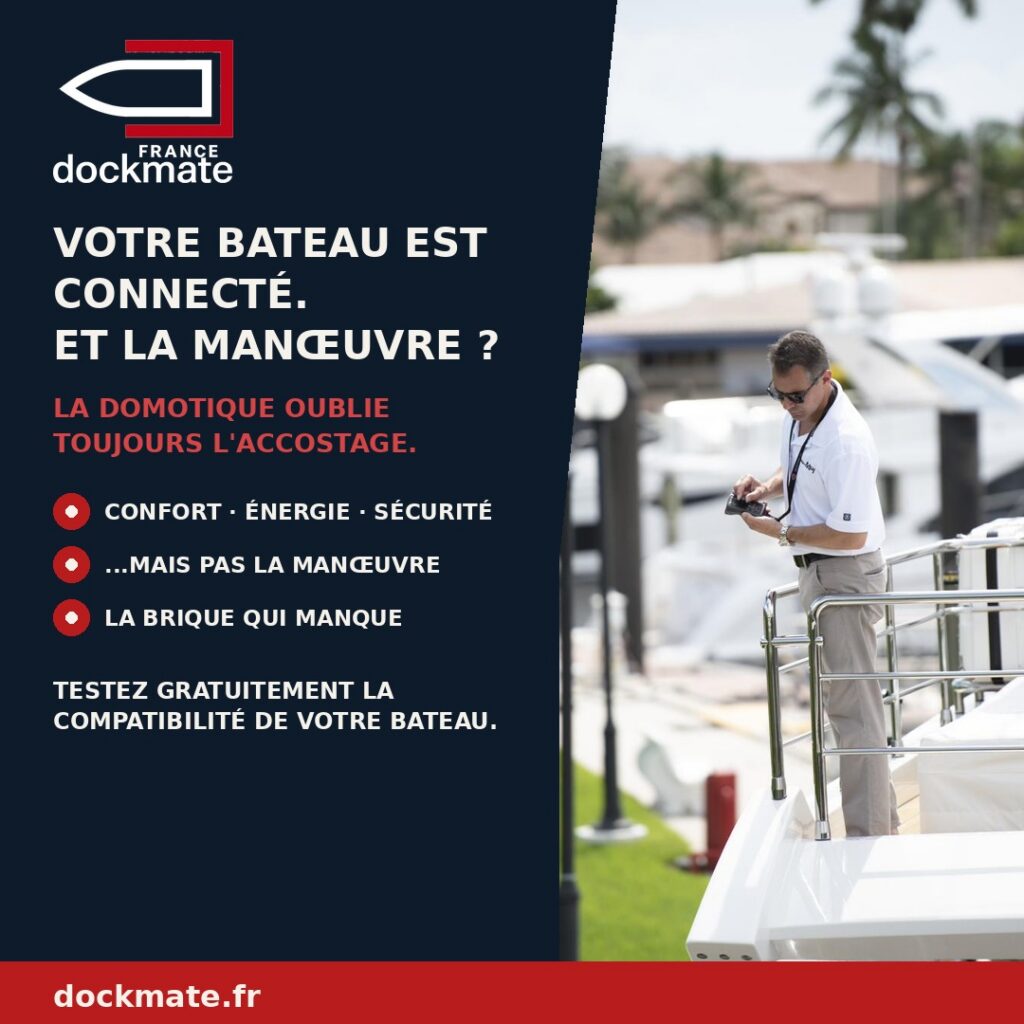
The missing piece: the maneuvering remote control
It is exactly this void that a wireless docking remote control fills. It does not perform boat automation in the classic sense—it controls neither your lighting nor your AC. It does one thing, but it does it perfectly: it remotes the maneuvering controls.
The principle is simple. The controls for your engines, thrusters, and windlass are grouped into a handheld unit that you wear around your neck. You maneuver wirelessly from any point on the boat. It is the logical extension of remote boat control, applied to the moment that matters most.
Finally seeing what you are doing
When it comes to docking, the best vantage point is never behind the helm. It is at the bow, the stern, or the side. With a remote control, you are where you need to be. You aim for the dock, you watch the neighbor, you handle the line yourself.
A different philosophy from automation
Where boat automation relies on permanent connection and remote piloting via the internet, the maneuvering remote control relies on the opposite: a direct, dedicated, and secure link, without depending on a network. When maneuvering, you don’t want a system that “thinks.” You want an immediate and reliable response. It is a different, complementary logic.
A truly complete boat: comfort AND maneuvering
The ideal boat of 2026 does not choose between the two. It combines good boat automation—for comfort, energy, and safety—and a maneuvering remote control for docking. The first system simplifies your life on board. The second simplifies your life in the harbor.
Both share the same promise: regaining control, reducing stress, and enjoying more. Boat automation does this for life at the dock and while cruising. The remote control does it for maneuvering. Together, they finally make the boat as simple as it should be.
To go further, we detail the operation of a wireless joystick for boats and the principle of the wireless docking system in dedicated articles.
Is your boat ready for connected maneuvering?
Good news: if your boat is already geared toward automation, it likely has electronic controls. And that is exactly what is needed to install a maneuvering remote control.
The easiest way is to check. In a few clicks, you will know if your boat can be equipped.
👉 Take the compatibility test for your boat. It is free and fast. To discover the brand, you can also view the Dockmate France profile.
FAQ: boat automation maneuvering
Does boat automation allow for maneuvering the boat?
No, and this is a point that is often misunderstood. Boat automation manages comfort, energy, and safety (lighting, air conditioning, batteries, alarms), but not maneuvering. To dock wirelessly, you need a dedicated docking remote control, a separate component from automation.
Is a docking remote control considered boat automation?
Not in the classic sense. Boat automation automates onboard functions via a connected network. A maneuvering remote control, on the other hand, remotes the engine and thruster controls through a direct and secure link. The two are complementary but based on different logics.
Can you have both automation and a maneuvering remote control on the same boat?
Absolutely, and it is even ideal. Boat automation takes care of comfort and safety, while the remote control takes care of docking. A boat equipped with both is complete, from the anchorage to the pontoon.
Is my connected boat compatible with a docking remote control?
If it is already automation-oriented, it likely has electronic controls, which is the main requirement. The most reliable way is still to take the compatibility test on dockmate.fr for a response tailored to your configuration.